
How to Write Title Tags and Meta Descriptions That Get Clicks
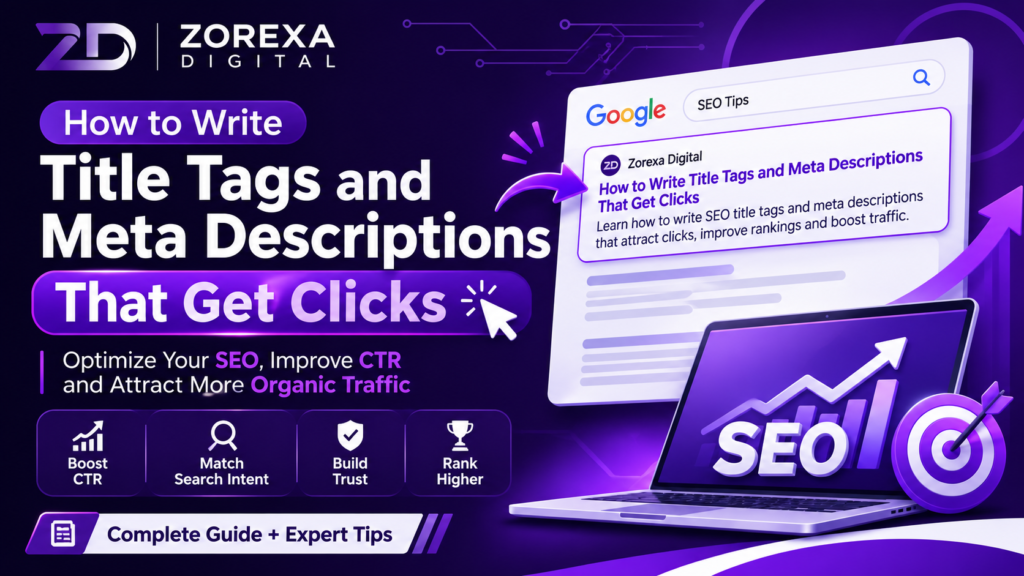
Getting your website to appear in Google search results is an important part of SEO, but getting users to click on your page is equally important. Even when a website ranks on the first page of Google, poorly written title tags and meta descriptions can make users choose another result.
This is where SEO title tags and meta descriptions become important. They provide users with a quick understanding of what a webpage offers before they visit it.
A well-written SEO title tells search engines and users what a page is about, while an effective meta description explains why the page is worth visiting. Together, they help create a more relevant and attractive search result.
In this guide, we will explain how to write title tags and meta descriptions that attract clicks, match search intent, support on-page SEO, and improve your website’s search appearance. You will also learn practical examples, optimization techniques, common mistakes, and ways to measure performance.
What Are Title Tags and Meta Descriptions in SEO?
Title tags and meta descriptions are HTML elements that provide information about a webpage.
A title tag defines the page title that can appear in search engine results, browser tabs, and other places.
A meta description is a short summary of a webpage that search engines may use to generate the descriptive text displayed beneath the search result title.
Both elements help communicate the relevance and purpose of a webpage.
What Is an SEO Title Tag?
An SEO title tag is an HTML element that describes the main topic of a webpage. It is placed inside the HTML head section using the title element.
For example:
<title>Best SEO Services in Pakistan | Zorexa Digital</title>
This title clearly communicates the page topic and includes the brand name.
Google uses several sources to generate title links in search results, including the title element, main heading, prominent page content, and other signals. Therefore, writing a relevant title tag is important, but Google may sometimes display a different title.
What Is a Meta Description?
A meta description is an HTML element that summarizes the content of a webpage. It helps users understand what they can expect after clicking a search result.
Example:
<meta name="description" content="Explore professional SEO services in Pakistan. Discover strategies for improving rankings, increasing organic traffic, and growing your business with Zorexa Digital.">
A good meta description should accurately explain the page, highlight its value, and encourage relevant users to visit.
Why Are Title Tags and Meta Descriptions Important for SEO?
Title tags and meta descriptions play an important role in how your website appears in search engine results pages (SERPs).
Although a meta description is not a direct Google ranking factor, both elements can influence how users interact with your search listings.
Here are the main benefits:
1. Improve Organic Click-Through Rate (CTR)
Click-through rate (CTR) measures the percentage of users who click on your website after seeing it in search results.
For example, if 1,000 people see your search result and 50 click on it, your CTR is 5%.
A clear title and relevant description can make your result more attractive to users who are searching for your services or information.
2. Communicate Search Intent
Search intent refers to the reason behind a user’s search query.
For example:
Informational: How does SEO work?
Commercial: Best SEO agencies in Pakistan
Transactional: Hire an SEO expert
Navigational: Zorexa Digital website
Your title tag and meta description should reflect the intent behind the target keyword. When your search snippet matches what users are looking for, they can make a more informed decision about clicking.
3. Improve Search Result Relevance
Search engines use different signals to understand webpage content. A descriptive title helps communicate the main subject of a page.
When your title, H1 heading, content, and meta description consistently represent the same topic, users receive a clearer and more relevant experience.
4. Build User Trust
Users are more likely to consider a search result when its title and description accurately explain what they will find.
Avoid exaggerated claims, misleading promises, and descriptions that do not match the actual page content.
Trust begins before a visitor even reaches your website.
How to Write SEO Title Tags That Get More Clicks
Writing a good SEO title requires more than inserting a primary keyword. You need to understand what users are searching for and communicate the value of your content in a concise way.
Follow these practical steps.
1. Include Your Primary Keyword Naturally
Your primary keyword should communicate the main topic of your webpage.
For example, if your target keyword is “How to Write Meta Descriptions,” your title could be:
How to Write Meta Descriptions That Improve SEO and CTR
This title includes the primary keyword naturally and explains the benefit of reading the article.
Avoid repeating the same keyword multiple times. Keyword stuffing makes titles difficult to read and can make search results look unnatural.
2. Match the Search Intent
Before writing a title, analyze the search intent behind your target keyword.
Ask yourself:
What information does the user want?
Are they looking for a tutorial, comparison, service, or product?
What would make your result relevant to their search?
For example:
Target keyword: SEO Title Tag Best Practices
Better title: SEO Title Tag Best Practices: 10 Tips for Better Search Results
This title directly addresses the informational intent and tells readers what they can expect.
3. Make Your Title Clear and Specific
A good SEO title should explain the page topic without making users guess.
Compare these examples:
Weak Title: SEO Tips and Tricks
Better Title: 10 SEO Title Tag Tips to Improve Search Visibility
The second example communicates a specific topic and provides a clear reason to explore the page.
Specific titles help users distinguish your content from competing search results.
4. Use Numbers When They Add Value
Numbers can make titles more specific and communicate the structure of an article.
Examples include:
7 SEO Title Tag Mistakes to Avoid
10 Meta Description Examples for Better CTR
5 Ways to Improve Your Organic Click-Through Rate
However, only use numbers when the content genuinely supports them. Do not promise 10 tips and deliver only five.
5. Add Your Brand Name Strategically
Adding your brand name can help users recognize your business.
For example:
SEO Services in Pakistan | Zorexa Digital
For most informational blog posts, prioritize the actual article topic. Add the brand name when it fits naturally without making the title unnecessarily long.
Avoid repeating your brand name across every page when it creates repetitive or confusing titles.
6. Avoid Unnecessary Title Length
There is no fixed character limit for HTML title tags. However, Google may shorten title links depending on the available display space.
As a practical starting point, many SEO professionals aim for approximately 50–60 characters, but this is a guideline rather than a Google rule.
Focus on placing the most important information near the beginning of the title.
7. Make Every Title Unique
Every important page on your website should have a distinct title.
For example, an SEO agency website might have separate pages for:
Local SEO Services
Technical SEO Services
Ecommerce SEO Services
Enterprise SEO Services
On-Page SEO Services
Using the same title for all these pages makes it difficult for users to understand their differences.
Create titles that accurately represent the specific service and its benefits.
How to Write Meta Descriptions That Encourage Clicks
A meta description should work like a short introduction to your webpage. Its purpose is to explain the content and help users understand why it matches their search.
Here are some effective practices.
1. Summarize the Main Content
Your description should communicate the most important information on the page.
For example:
Target Keyword: Technical SEO Services
Meta Description: Improve your website’s technical performance with professional technical SEO services. Discover how better crawling, indexing, and site structure support organic growth.
This description explains the service and highlights relevant benefits.
2. Include Your Primary Keyword Naturally
Including your primary keyword in the meta description can help users recognize the relevance of your result.
However, do not force keywords into every sentence.
Use related terms and natural variations where appropriate.
For example, a page targeting “SEO Title Tags” may naturally include:
Search engine optimization
Organic search results
Title tag optimization
Search visibility
Click-through rate
The goal is to communicate the topic clearly rather than repeat keywords.
3. Highlight a Clear Benefit
Users want to know what they will gain by visiting your page.
Instead of writing a generic description, explain the value of your content.
Weak description:
“Read our article about SEO titles and meta descriptions. Learn more about SEO.”
Better description:
“Learn how to write compelling SEO titles and meta descriptions with practical examples, optimization tips, and strategies for attracting relevant organic clicks.”
The improved version communicates exactly what the reader will learn.
4. Add a Relevant Call to Action
A call to action (CTA) can encourage users to explore your webpage.
Examples include:
Learn how it works.
Explore practical examples.
Discover effective strategies.
Read our complete guide.
Find the right solution for your business.
Choose a CTA that matches the purpose of your page. Avoid aggressive or misleading language.
5. Keep Meta Descriptions Concise
Google does not specify a fixed character limit for meta descriptions. Search snippets are shortened according to the available display space.
As a practical guideline, you can initially aim for around 150–160 characters for many pages.
However, do not sacrifice important information just to meet a character count. Make the opening sentence meaningful because the displayed snippet can vary.
6. Write Unique Meta Descriptions for Every Page
Avoid using the same meta description across multiple pages.
For example, your technical SEO page should explain technical SEO, while your ecommerce SEO page should highlight ecommerce-specific optimization.
Unique descriptions help communicate the individual purpose of each URL.
Title Tag vs. Meta Description: What Is the Difference?
Although title tags and meta descriptions work together, they serve different purposes.
| Feature | Title Tag | Meta Description |
|---|---|---|
| Main purpose | Describe the webpage title | Summarize the webpage |
| HTML element | <title> | <meta name="description"> |
| Search appearance | Main clickable headline | Supporting description |
| Keyword usage | Primary topic naturally | Relevant keywords naturally |
| Direct ranking role | Relevant SEO signal | Not a direct ranking factor |
| Main objective | Communicate page relevance | Explain value and encourage clicks |
Both should accurately represent the same webpage and provide a consistent message.
Best SEO Title Tag and Meta Description Examples
Practical examples make it easier to understand how to optimize metadata for different types of webpages.
Here are some examples for common website categories.
1. Blog Article Example
Target Keyword: How to Improve Website SEO
SEO Title: How to Improve Website SEO: 10 Practical Tips
Meta Description: Discover 10 practical ways to improve website SEO, optimize on-page elements, strengthen technical performance, and grow organic search traffic.
2. Ecommerce Product Page Example
Target Keyword: Buy Wireless Headphones Online
SEO Title: Wireless Headphones: Features and Buying Guide
Meta Description: Explore wireless headphones, compare important features, and find the right option based on sound quality, comfort, battery life, and budget.
3. Local Business Page Example
Target Keyword: Digital Marketing Agency in Karachi
SEO Title: Digital Marketing Agency in Karachi | Zorexa Digital
Meta Description: Looking for digital marketing services in Karachi? Explore SEO, website optimization, and digital growth solutions from Zorexa Digital.
4. Service Page Example
Target Keyword: Local SEO Services
SEO Title: Local SEO Services to Grow Your Business
Meta Description: Improve your local search visibility with targeted local SEO strategies, Google Business Profile optimization, and location-focused website improvements.
5. Technical SEO Page Example
Target Keyword: Technical SEO Services
SEO Title: Technical SEO Services for Better Website Performance
Meta Description: Discover technical SEO solutions for crawling, indexing, website structure, and performance to build a stronger foundation for organic search growth.
Common Title Tag and Meta Description Mistakes to Avoid
Even experienced website owners make mistakes when optimizing metadata. These problems can affect search result presentation and user experience.
1. Keyword Stuffing
Repeating the same keyword unnecessarily makes titles and descriptions look unnatural.
Instead, use the primary keyword once where appropriate and explain the page topic naturally.
2. Writing Duplicate Titles
Multiple pages with identical titles can confuse users and make it harder to distinguish between different pages.
Create unique titles that reflect each page’s actual purpose.
3. Using Generic Meta Descriptions
Descriptions such as “Welcome to our website” or “Read more about our services” do not communicate meaningful information.
Explain what makes the particular page useful.
4. Making Misleading Promises
Never promise results that your content or services cannot deliver.
For example, avoid titles such as “Guaranteed Number One Google Rankings in 24 Hours.”
Accurate messaging builds trust and attracts more relevant visitors.
5. Ignoring Mobile Search Results
Users search from different devices, and available display space varies.
Place the main topic and important information near the beginning of your title and description.
6. Forgetting to Update Old Metadata
Older pages may have outdated titles, descriptions, offers, or dates.
Review important URLs regularly and update metadata whenever the page’s actual content changes.
How to Optimize Title Tags and Meta Descriptions for AEO and GEO
Search behavior is evolving. Users are increasingly asking questions through AI-powered search experiences, conversational search tools, and answer engines.
Answer Engine Optimization (AEO) focuses on making content useful for answering specific questions. Generative Engine Optimization (GEO) focuses on improving the visibility and representation of information in generative AI search experiences.
Although title tags and meta descriptions alone cannot guarantee AI visibility, they contribute to a clear and consistent understanding of your webpage.
Here are some practical ways to support AEO and GEO.
1. Use Clear and Descriptive Titles
AI systems and search engines need to understand the main topic of a page.
Write titles that clearly identify the subject rather than relying on vague or overly creative wording.
For example:
Instead of: “The Secret Behind Better Rankings”
Use: “How to Improve Website Rankings With On-Page SEO”
The second title communicates the subject more directly.
2. Answer Important Questions Directly
Include relevant questions and concise answers within your article.
For example:
Question: What is a good SEO title tag?
A good SEO title tag is unique, descriptive, concise, and accurately represents the main content of a webpage. It should communicate the topic clearly and match the user’s search intent.
Direct answers improve usability and make important information easier to understand.
3. Create Meaningful Content Sections
Organize your content with descriptive H2 and H3 headings.
For example:
What Is a Title Tag?
How Long Should an SEO Title Be?
What Makes a Good Meta Description?
How Do You Improve Organic CTR?
This structure helps readers navigate your article and makes individual information sections easier to interpret.
4. Maintain Consistency Across Your Page
Your SEO title, H1 heading, meta description, and actual content should describe the same subject.
For example, if your title promises a guide to meta description writing, your article should provide practical instructions and examples rather than unrelated SEO information.
5. Support Your Information With Reliable Sources
Use trustworthy sources when explaining technical SEO concepts, search engine guidelines, and optimization practices.
For Google-specific recommendations, refer to Google Search Central.
Original examples, practical experience, and accurate explanations can also make your content more valuable.
6. Focus on People-First Content
Do not write metadata or articles exclusively for AI systems.
Focus on answering real questions, providing useful information, and making the page valuable to visitors.
Google’s guidance for generative AI search emphasizes established SEO fundamentals and unique, helpful content rather than special AEO or GEO tricks.
How to Test and Measure Title Tag and Meta Description Performance
Writing optimized metadata is only the first step. You should also monitor how users interact with your search results.
Google Search Console is one of the most useful tools for understanding organic search performance.
Follow these steps:
Step 1: Open Google Search Console
Select your verified website property and navigate to the Performance report.
Step 2: Review Search Performance
Analyze important metrics, including:
Impressions: How often your pages appear in search results.
Clicks: How many times users visit your website through search results.
Average CTR: The percentage of impressions that generate clicks.
Average Position: Your website’s average position for selected search queries.
Step 3: Identify Pages With High Impressions but Low CTR
Look for pages that receive significant impressions but relatively few clicks.
Compare their titles and descriptions with the search queries generating those impressions.
Step 4: Improve Your Metadata
Rewrite titles to communicate the page topic more clearly. Improve descriptions by highlighting relevant information and the value of the page.
Step 5: Monitor Results
Compare performance over an appropriate period while considering ranking changes, seasonality, query mix, and search appearance.
Remember that CTR varies by query, position, device, and search features. A single CTR benchmark does not apply to every website.
Frequently Asked Questions (FAQs)
1. What is the ideal length of an SEO title tag?
There is no fixed character limit for SEO title tags. However, many SEO professionals use approximately 50–60 characters as a practical starting point. Google may shorten titles based on the available display space.
2. How long should a meta description be for SEO?
A meta description can be any length, but Google truncates search snippets when necessary. Around 150–160 characters is a common starting guideline, not a guaranteed display limit.
3. Do meta descriptions directly affect Google rankings?
No. Meta descriptions are not a direct Google ranking factor. However, an accurate and compelling description can help users understand a search result and potentially influence organic click-through rate.
4. Does Google always display my meta description?
No. Google primarily generates snippets from webpage content and may use your meta description when it provides a better summary for a particular search query.
5. Should I include my primary keyword in the title tag?
Yes, when it naturally describes the page. Including the primary keyword can help communicate the topic, but avoid keyword stuffing or unnatural repetition.
6. Can I use the same meta description on multiple pages?
It is better to write unique meta descriptions for important pages. Each description should accurately summarize the specific page and explain its value to potential visitors.
7. How do I check whether my title tag is working?
Use Google Search Console to monitor impressions, clicks, average CTR, and average position. Compare performance over time and evaluate whether your title accurately matches the search queries bringing impressions.
8. Are title tags and meta descriptions important for AI search?
They help communicate webpage topics and context, but they do not guarantee inclusion in AI-generated answers. Strong technical SEO, accessible content, accurate information, and useful page content remain important.
Final Thoughts
Writing effective title tags and meta descriptions is an essential part of on-page SEO. A well-optimized title communicates the main topic, while a relevant meta description explains the value of visiting the webpage.
The most effective approach is to understand search intent, use keywords naturally, write unique metadata, and provide accurate information that matches the actual content.
Do not focus only on search engine requirements. Think about what users want to find and why they should choose your webpage over other search results.
At Zorexa Digital, we believe successful SEO starts with understanding users, creating valuable content, and building a strong search experience. Whether you are optimizing a blog, service page, or ecommerce website, improving your metadata is a practical step toward attracting more relevant organic traffic.